Launch offer — valid today only

📄 Digital book in PDF · read it on your phone or print it

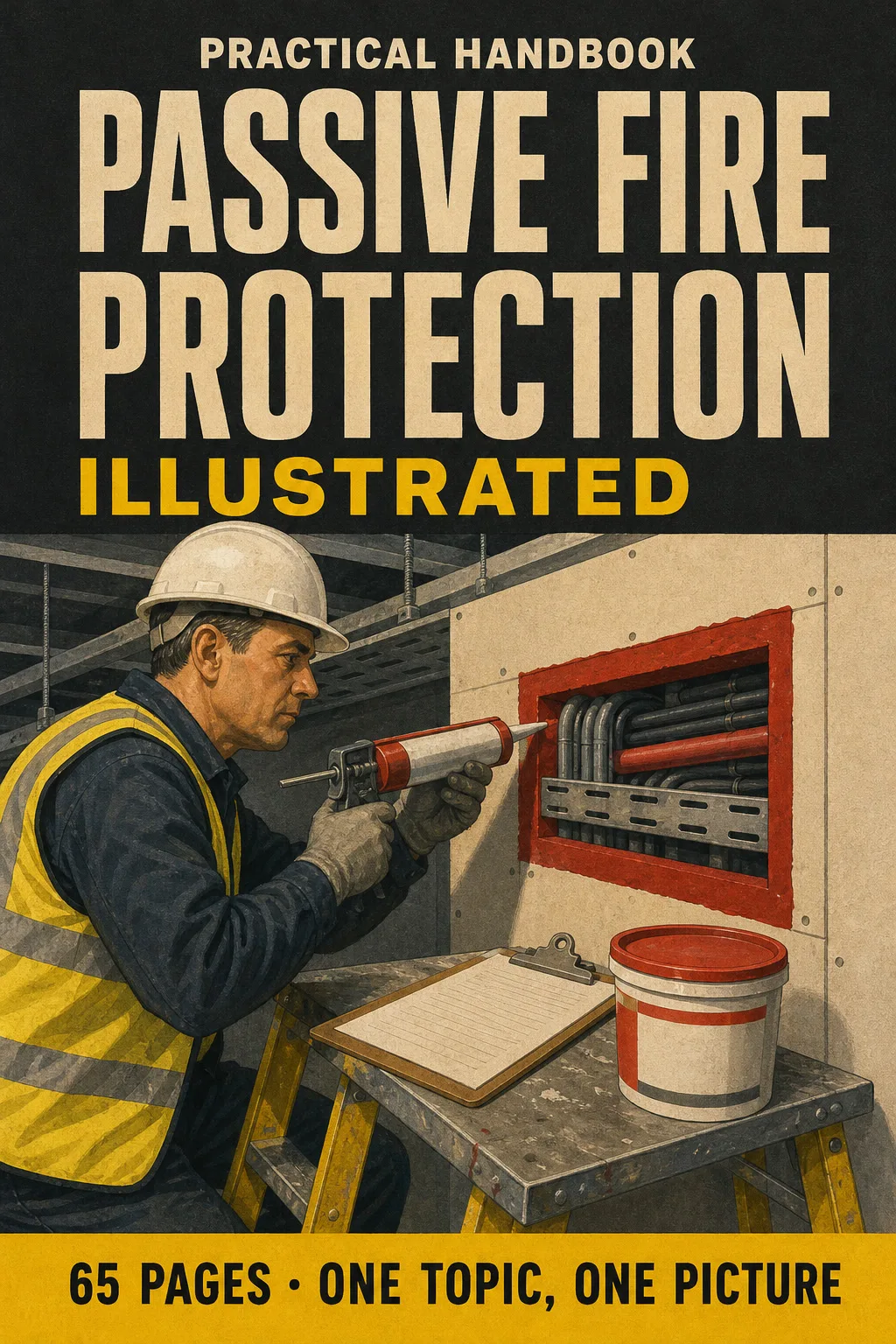
Passive Fire Protection and the IFE Level 3 in Drawings One Detail on Every Page

Compartmentation, E, I and R, pipe ends, collars and batts, head of wall, cavity barriers, fire doors and steel protection. Every topic has its own page: the drawing first, then what you need to remember. 65 illustrated pages.

START REVISING THIS WAY

🔒 Secure checkout · PDF by email · 30-day guarantee

Every topic, its own pageEvery seal and detail drawn, with the explanation beside it
65 illustrated pages8 parts, from how fire spreads to how the IFE Level 3 exam works
Up-to-date sourcesApproved Document B, the Building Safety Act 2022, BS EN 13501 and BS 8214, for England
PDF by emailFormat

Look Inside the Book

Every page has one large drawing and a box with the classifications, numbers and steps you need to know:

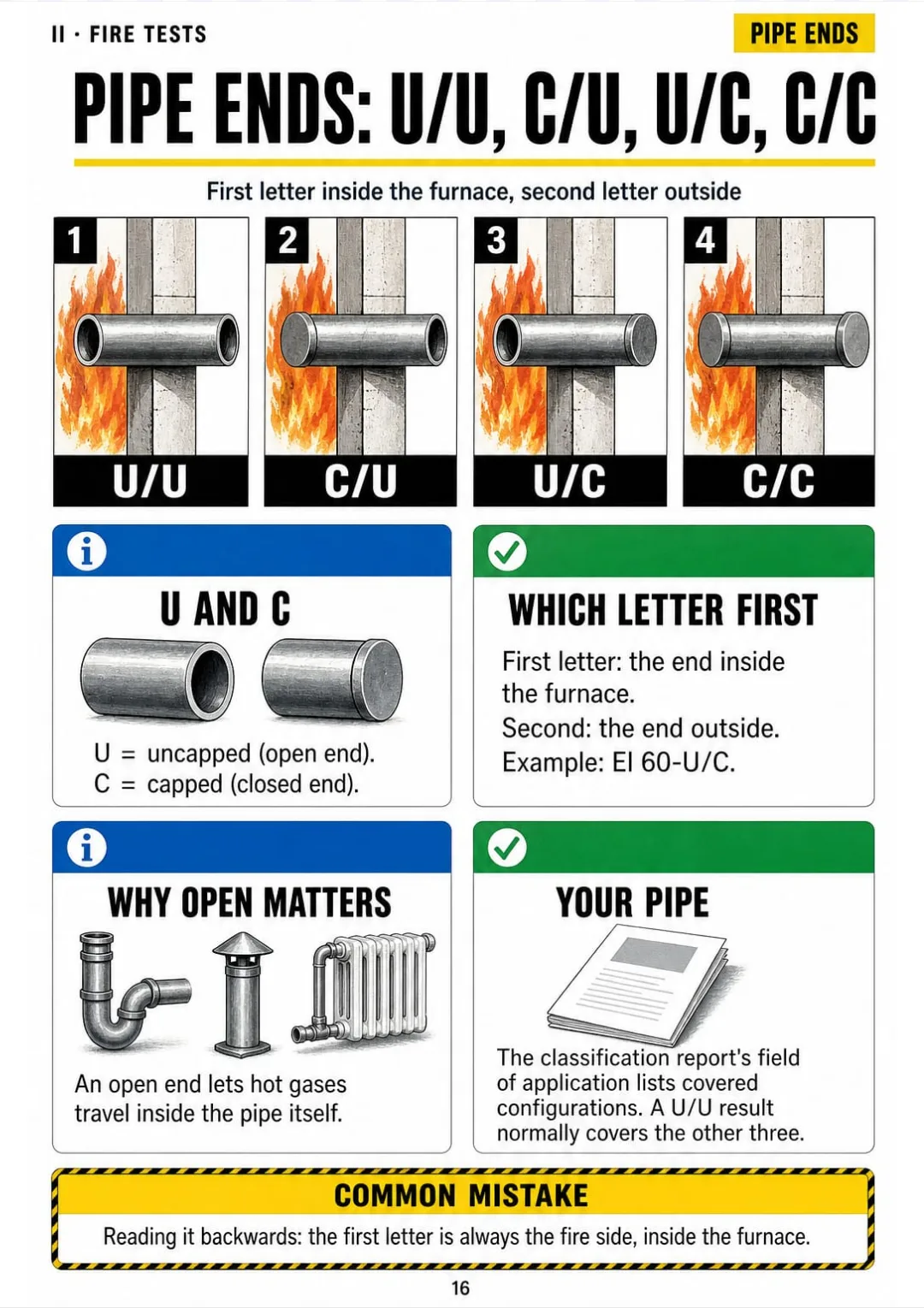
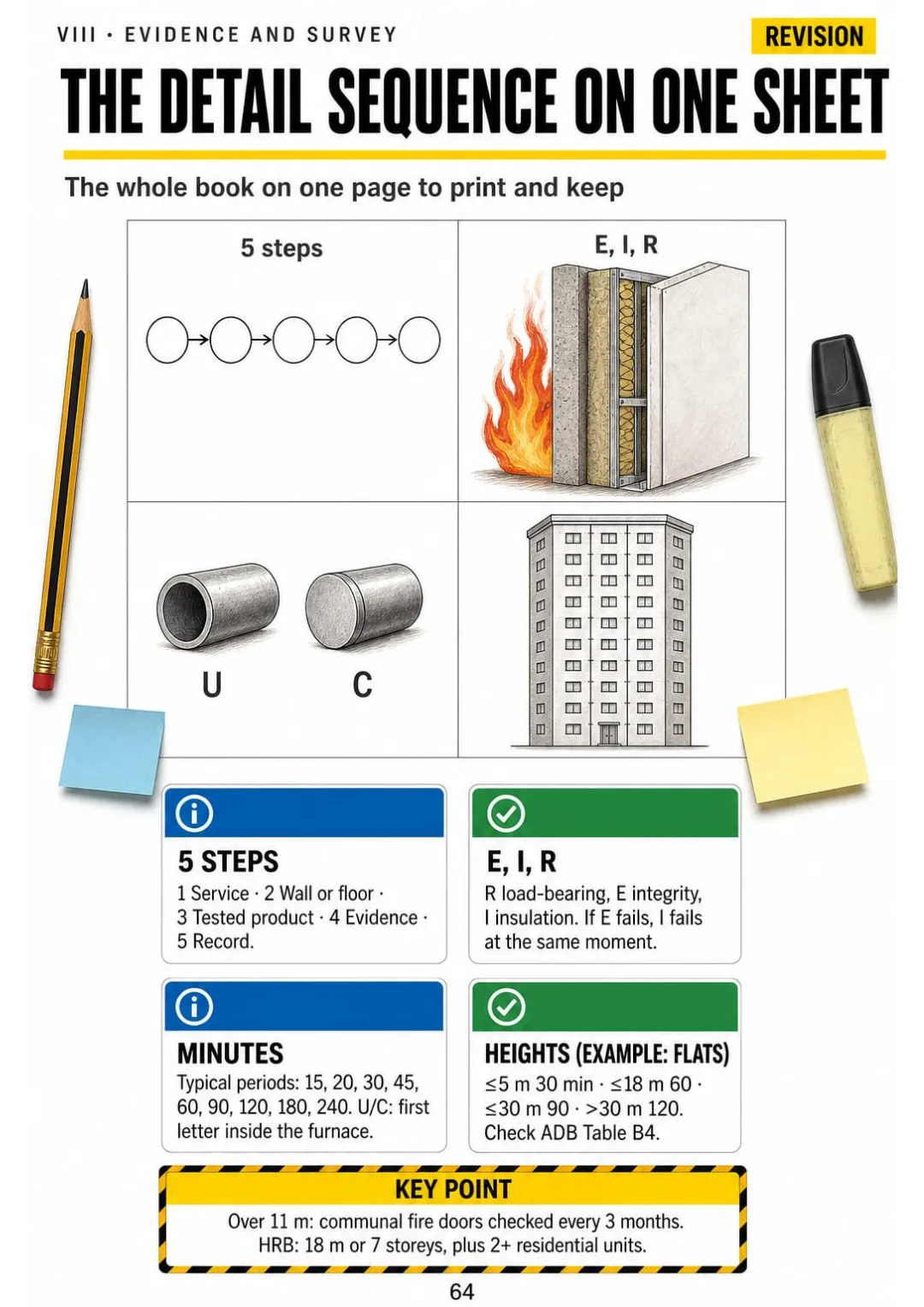
U = uncapped, C = capped; first letter inside the furnace (BS EN 1366-3).
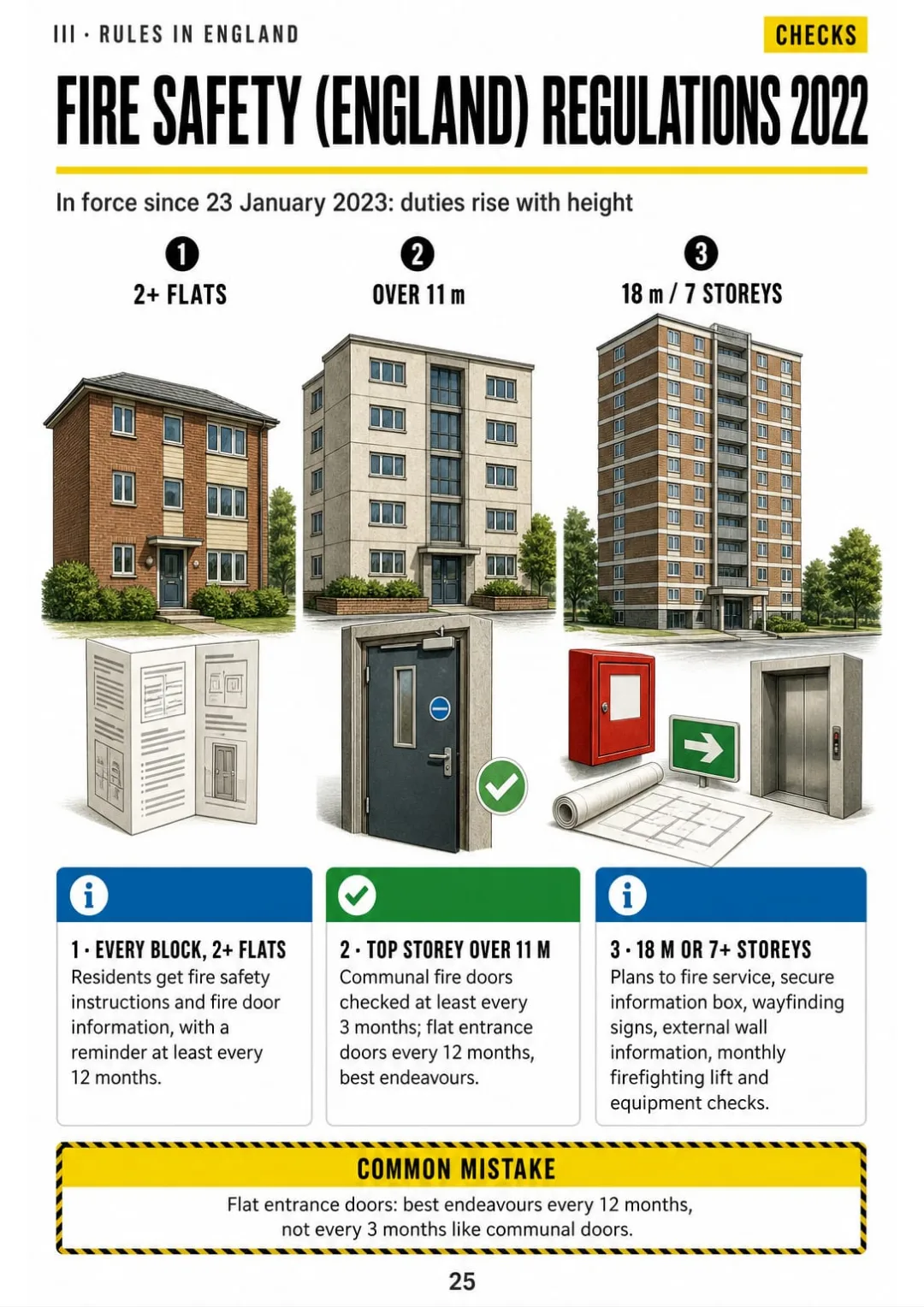
Over 11 m: communal fire doors every 3 months, flat entrance doors every 12 months.
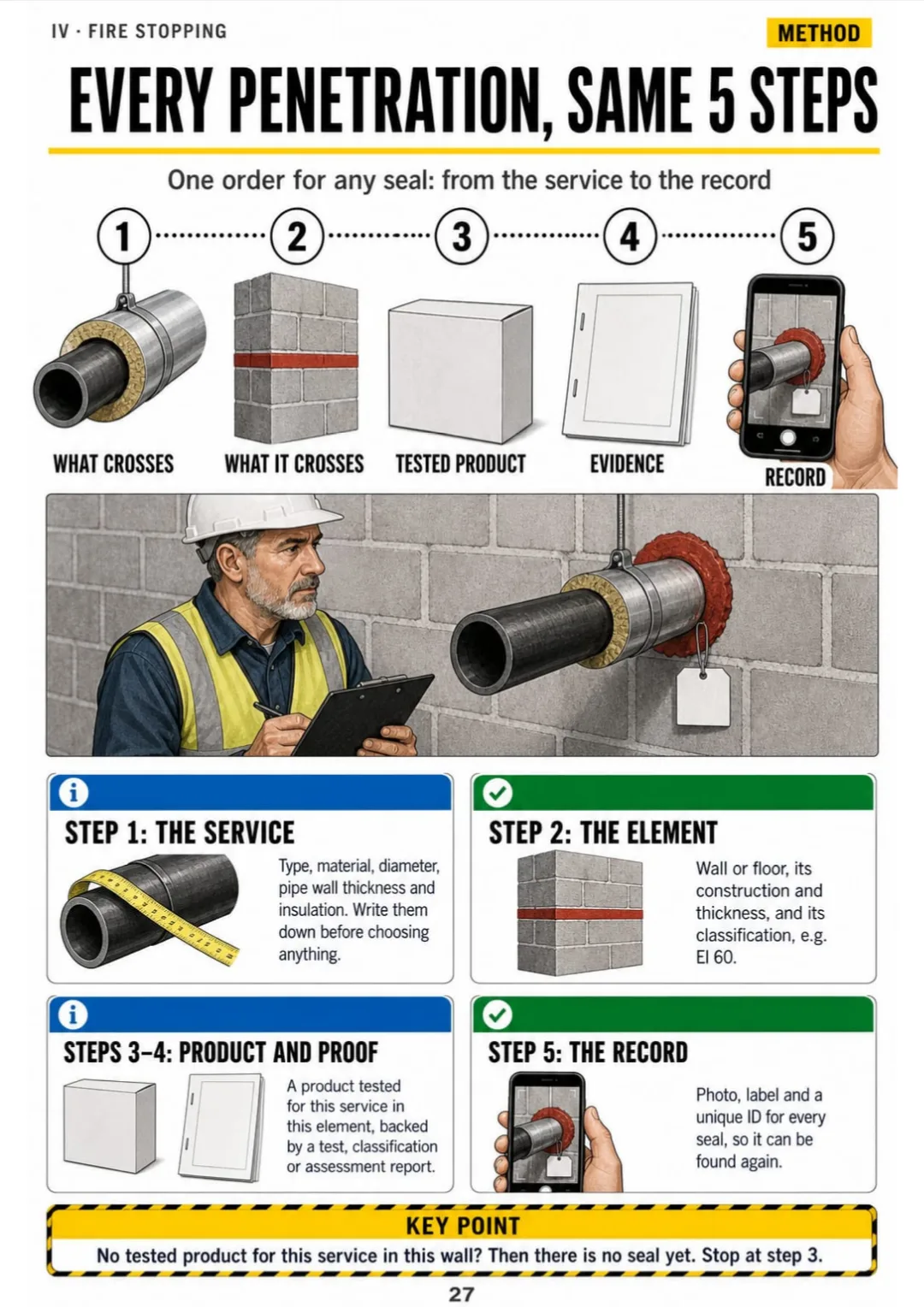
5 steps for any seal: service, element, tested product, evidence, record
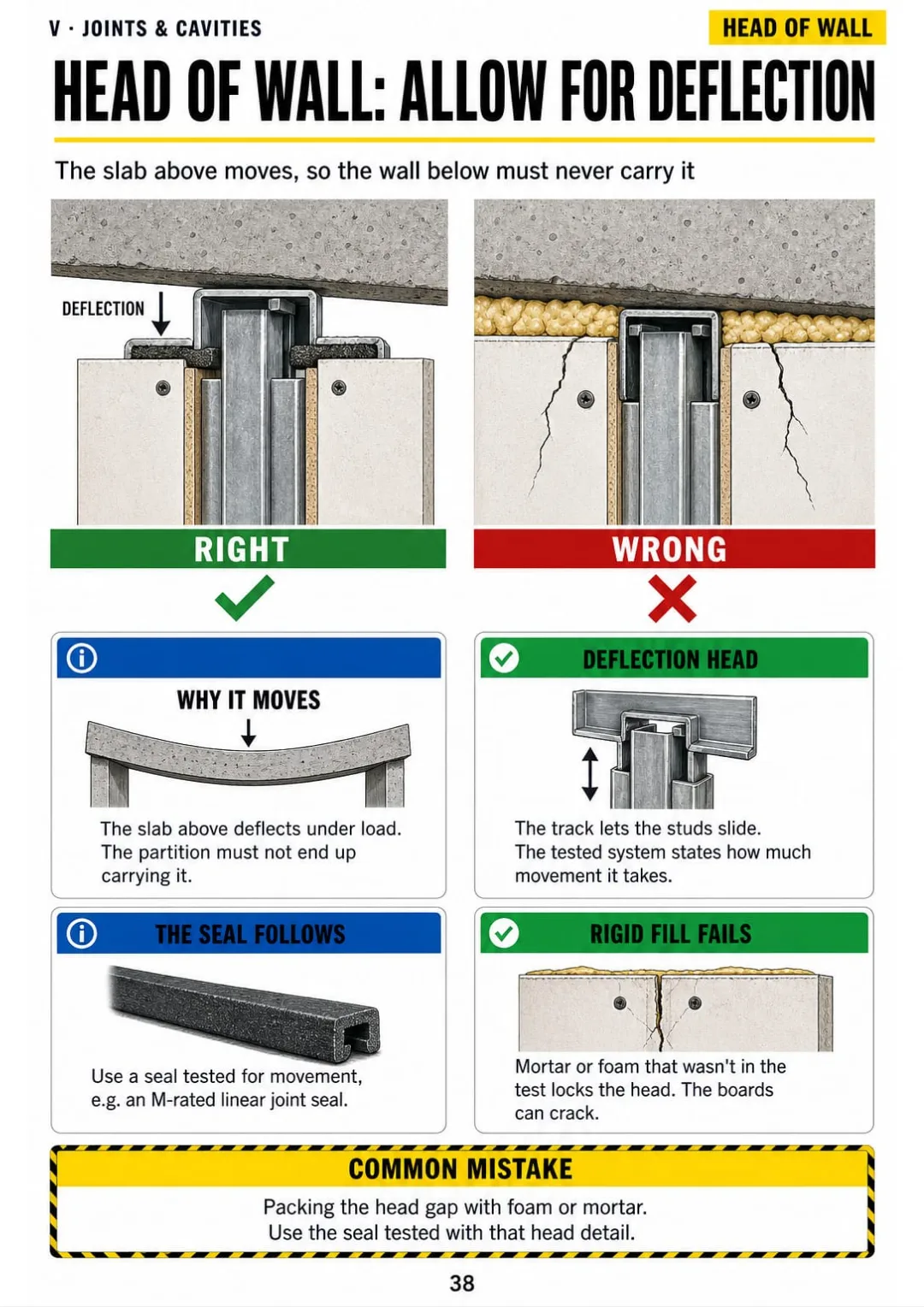
Deflection head plus a movement-rated seal, never a rigid fill of foam or mortar
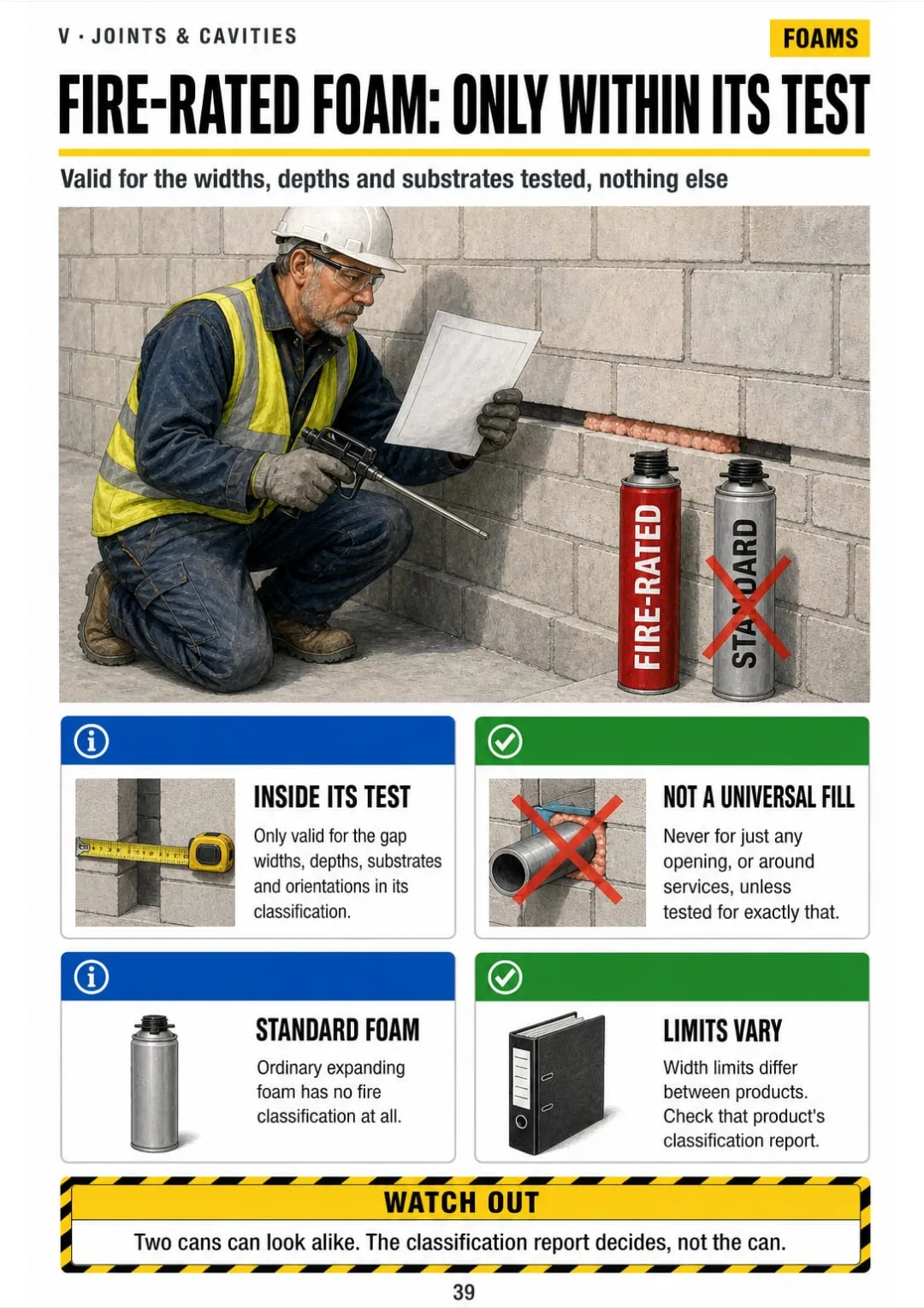
Fire-rated foam: only for the widths, depths and substrates in its test
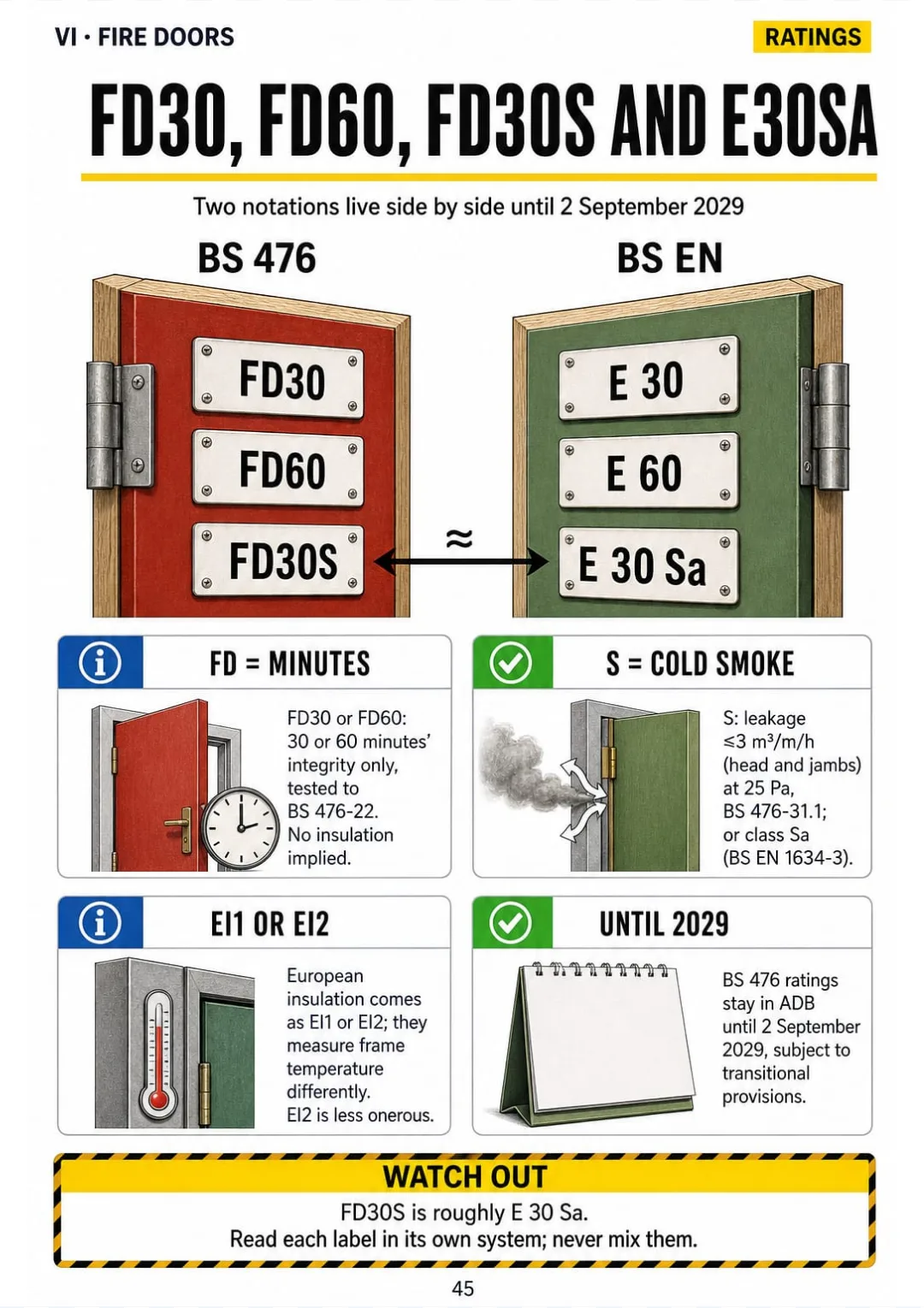
FD30S ≈ E 30 Sa: S means smoke leakage ≤3 m³/m/h at 25 Pa.
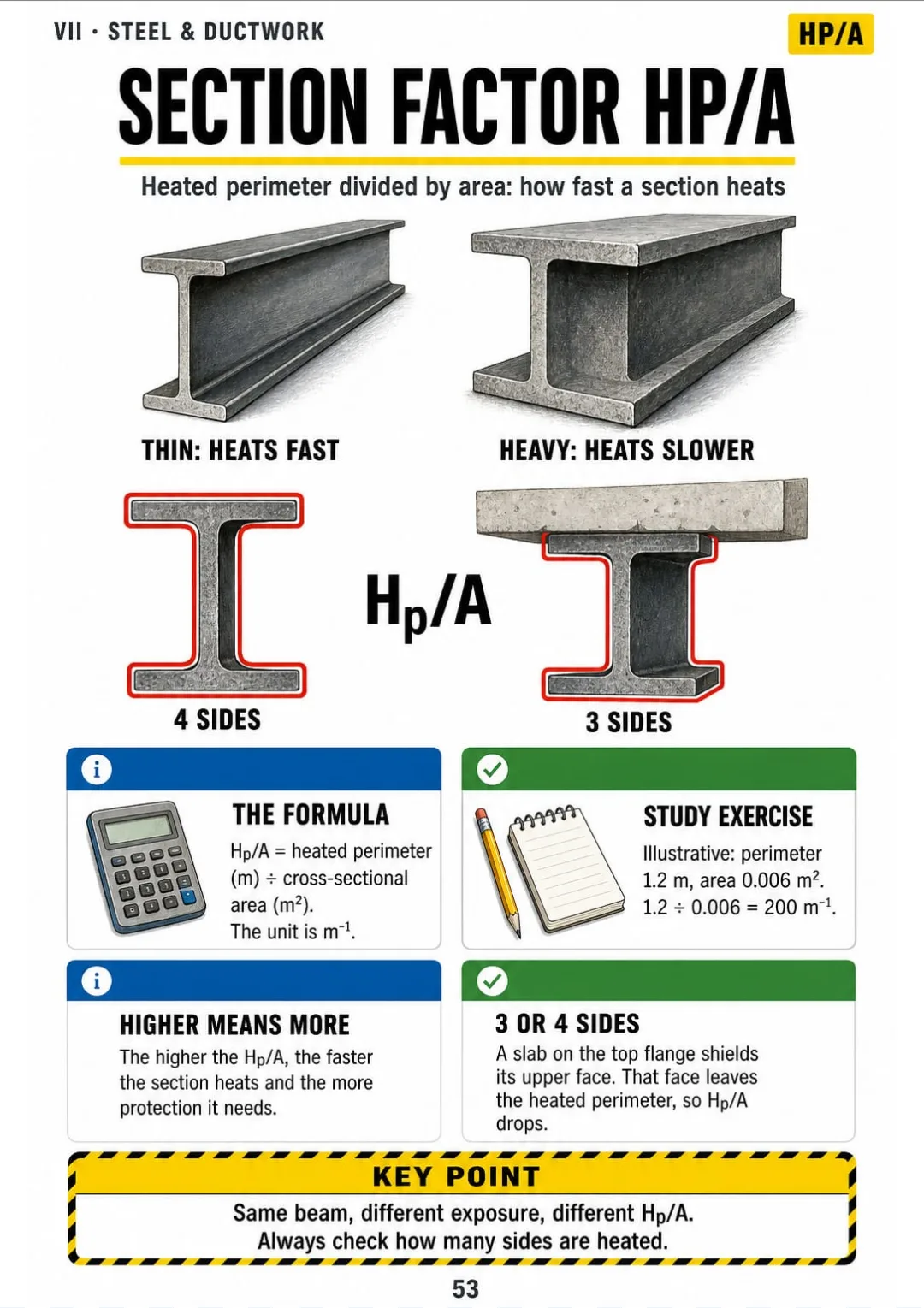
Hp/A = heated perimeter ÷ area, in m⁻¹: higher means more protection
Method, E/I/R, U/C, periods and height thresholds on a single sheet

Swipe to see more →

These are real pages from the book. The table of contents is the full one: 8 parts and 61 topics.

The Problem Isn't You. It's How It Was Explained.

You're on a riser landing. Pipes and cables come through a 60-minute wall, and you have to decide what goes in each gap, and how you'll prove it.

The manual spreads it over pages of clauses: the service in one chapter, the wall rating in another, evidence and records somewhere near the back. Nothing tells you which comes first.

5 steps for any seal: service, element, tested product, evidence, record

In this book it's one page: five steps, drawn in order. What service crosses, what the wall or floor is rated, which tested product fits, what evidence covers it, and how you record it.

Pipe ends, head of wall, cavity barriers, FD30S and section factor each get their own page too.

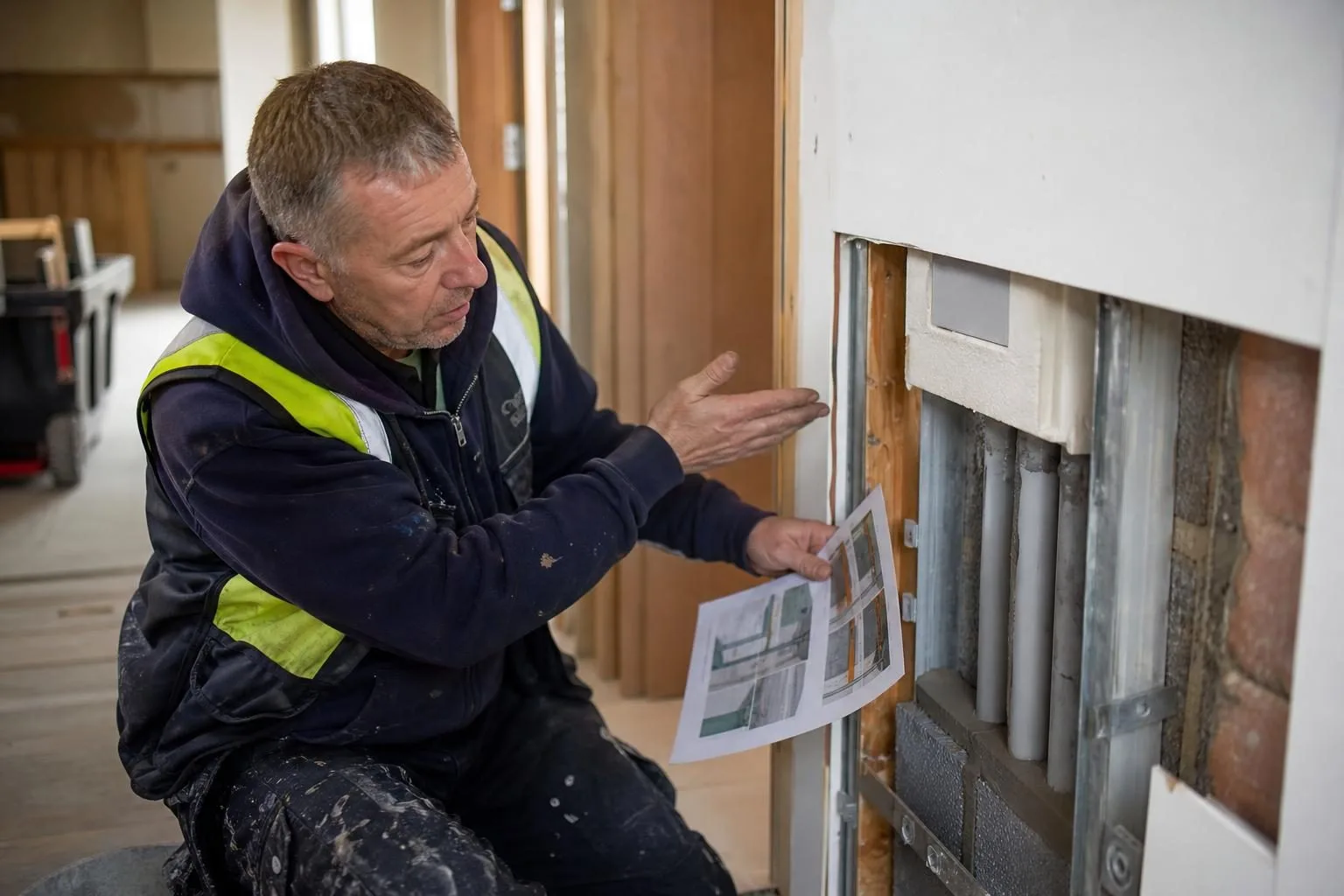
You read every penetration in the same order, and you can explain it to the inspector without opening the manual.

COMPARE FOR YOURSELF

Same Topic, Two Ways to Study It

THIS
  • The manual: line after line of regulations
  • Inspection duties explained only in words
  • You go into the exam still unsure
Under the Fire Safety (England) Regulations 2022, the responsible person for any multi-occupied residential building containing two or more sets of domestic premises must provide relevant fire safety instructions to residents. Where the building has a storey at a height of more than 11 metres above ground level, the responsible person shall undertake checks of all fire doors in the common parts at least every three months and shall use best endeavours to undertake checks of all flat entrance doors at least every twelve months.
FOR THIS
  • Each duty drawn on the building
  • The heights and intervals in one box
  • You see it and it makes sense
Over 11 m: communal fire doors every 3 months, flat entrance doors every 12 months.
CONTENTS

Take a Look at the 8 Parts and 61 Topics

How fire spreads, fire tests and classifications, the rules in England, fire stopping, joints and cavities, fire doors, steel protection and evidence on site: 65 pages, all illustrated.

IHow fire spreads and why we compartment · pp. 5-10
  1. Active vs passive fire protection
  2. How fire and smoke travel through a building
  3. The fire triangle and heat transfer
  4. Compartmentation: the building as a set of boxes
  5. Stay put, simultaneous evacuation and why compartments matter
  6. Grenfell and what changed for installers
IIFire tests and classifications · pp. 11-18
  1. The furnace test and the standard fire curve
  2. E, I and R: integrity, insulation, load-bearing
  3. How integrity fails: cotton pad and gap gauges
  4. How insulation fails: 140 °C and 180 °C
  5. Reading a classification: EI 60, REI 120, E 30-U/C
  6. Pipe end configurations: U/U, C/U, U/C, C/C
  7. BS 476 vs BS EN: two systems side by side
  8. Reaction to fire: A1 to F, s and d
IIIThe rules in England · pp. 19-26
  1. Approved Document B: how it is organised
  2. Purpose groups and building height
  3. Minimum fire resistance periods
  4. Which walls and floors must be compartment walls
  5. Protected shafts and protected stairs
  6. The Regulatory Reform (Fire Safety) Order and the Fire Safety Act 2021
  7. Fire Safety (England) Regulations 2022
  8. Building Safety Act 2022 and higher-risk buildings
IVFire stopping and penetration seals · pp. 27-36
  1. Every penetration in the same order
  2. Plastic pipes: why they need a collar
  3. Collars, wraps and sleeves
  4. Metal pipes: conduction is the problem
  5. Cables and cable bundles
  6. Batt systems: cutting and fitting
  7. Mastics and sealants: intumescent, ablative, acrylic
  8. Mixed penetrations and multi-service openings
  9. Penetrations in floors vs walls
  10. Penetrations in drylining walls
VJoints, cavities and walls · pp. 37-43
  1. Linear joint seals
  2. Head of wall: allowing for deflection
  3. Fire-rated foams: what they can and cannot do
  4. Cavity barriers: why hidden cavities kill
  5. Where cavity barriers go
  6. Cavity barriers in rainscreen façades
  7. Fire-resisting walls and floors: keep the system intact
VIFire doors · pp. 44-51
  1. The doorset is a system
  2. FD30, FD60, FD30S and E30Sa
  3. Gaps: the 3 mm rule
  4. Intumescent strips and smoke seals
  5. Hinges, closers and latches
  6. Glazing, signage and hold-open devices
  7. Installing the frame: the gap to the wall
  8. Inspecting a fire door in the same order
VIISteel protection and ductwork · pp. 52-57
  1. Why steel needs protecting
  2. Section factor Hp/A
  3. Boards, sprays and intumescent coatings
  4. Intumescent coatings: DFT and inspection
  5. Fire dampers and smoke dampers
  6. Fire-resisting ductwork and service risers
VIIIEvidence, records and survey on site · pp. 58-65
  1. Test report, classification report, assessment
  2. Field of application: does the test cover my site?
  3. Third-party certification and competence
  4. Recording an installation
  5. Walking a compartmentation survey
  6. Remediation: putting it right
  7. The detail sequence: final revision sheet
  8. IFE Level 3: how the exam works

One Page, One Topic, All Clear

Think of it this way:

You're walking a compartmentation survey and find a plastic waste pipe and a copper pipe through the same 60-minute wall. You have to say what's wrong with each and write it down.

You open the book at plastic pipes and see the pipe drawn in the fire: the plastic softens, the collar expands and closes the hole. Turn the page and the copper pipe is carrying the heat straight through.

Fire-rated foam: only for the widths, depths and substrates in its test

The same goes for pipe ends, head of wall, cavity barriers, fire door gaps and section factor: each one on its own page.

Passive Fire Protection Illustrated is 65 illustrated pages in 8 parts, one topic per page, ending with a revision sheet of the whole detail sequence and a page on how the IFE Level 3 exam works.

What you see drawn, you don't have to memorize.

What's Inside Passive Fire Protection Illustrated:

Ipp. 5-10

How fire spreads and why we compartment

Active vs passive protection, how fire and smoke travel, heat transfer, compartments as boxes, evacuation strategies and what changed after Grenfell.

IIpp. 11-18

Fire tests and classifications

The furnace test, integrity, insulation and load-bearing, how each one fails, reading EI 60 or REI 120, pipe end configurations, BS 476 vs BS EN and reaction to fire.

IIIpp. 19-26

The rules in England

How Approved Document B is organised, purpose groups and height, minimum periods, compartment walls and floors, protected shafts, the Fire Safety Order, the 2021 Act, the 2022 Regulations and the Building Safety Act.

IVpp. 27-36

Fire stopping and penetration seals

Every penetration in the same order, plastic and metal pipes, collars and wraps, cables, batts, mastics, mixed openings, floors vs walls and drylining.

Vpp. 37-43

Joints, cavities and walls

Linear joint seals, head of wall and deflection, what fire-rated foam can and can't do, cavity barriers and where they go, rainscreen façades and keeping the wall system intact.

VIpp. 44-51

Fire doors

The doorset as a system, FD30 to E30Sa, the 3 mm gap, intumescent strips and smoke seals, ironmongery, glazing and signage, fitting the frame and inspecting a door in order.

VIIpp. 52-57

Steel protection and ductwork

Why steel needs protecting, section factor Hp/A, boards, sprays and intumescent coatings, DFT and inspection, fire and smoke dampers, ductwork and risers.

VIIIpp. 58-65

Evidence, records and survey on site

Test report vs classification vs assessment, field of application, third-party certification, recording, walking a survey, remediation, the final revision sheet and how the IFE Level 3 works.

At the end of the book: The whole detail sequence on one revision sheet and a page on how the IFE Level 3 exam works.
Plus: 2 Free Books

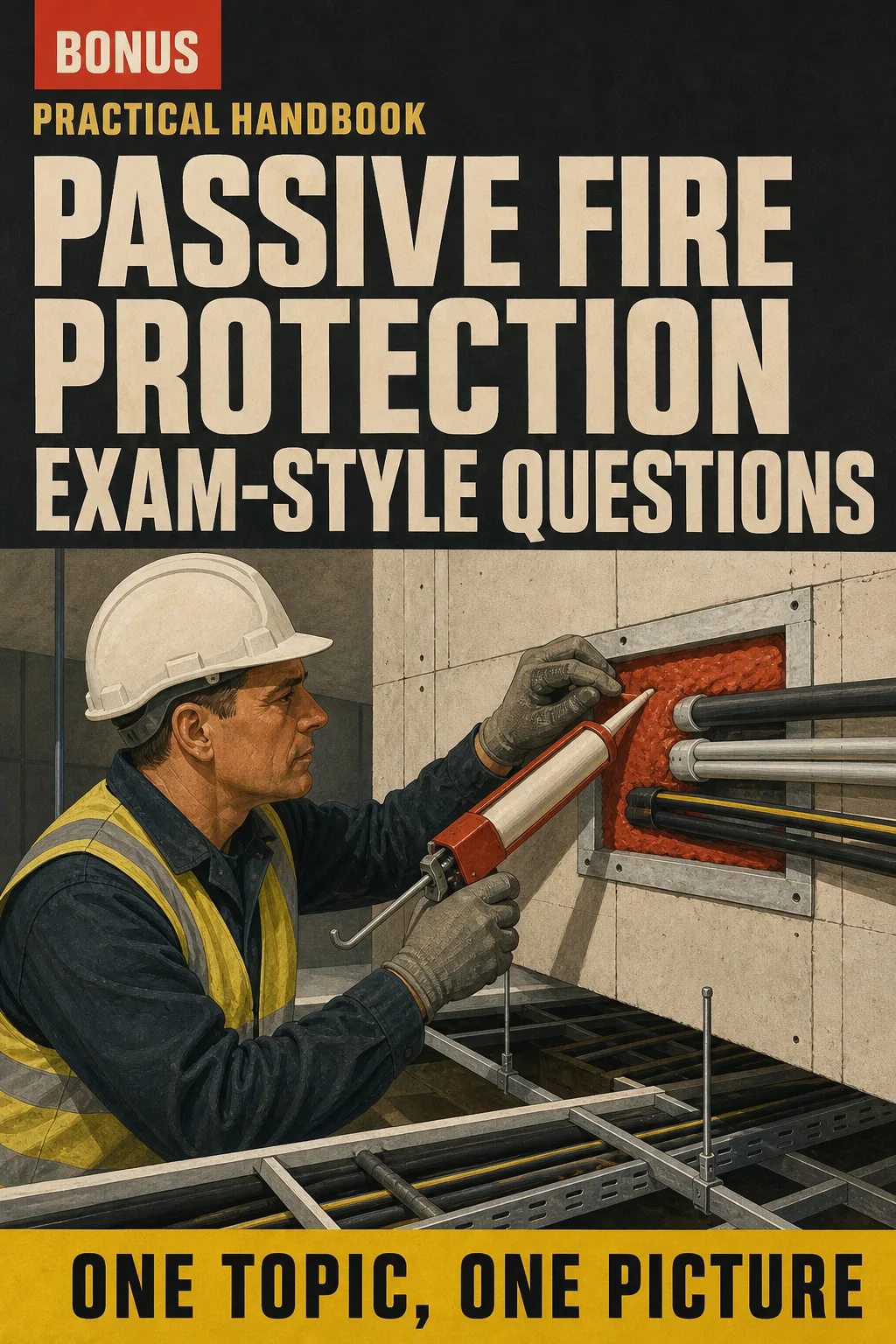
Passive Fire Protection Exam-Style Questions

BONUS 1: «Passive Fire Protection Exam-Style Questions»

Value on its own: US$ 17.90

Practise with exam-style questions on every topic, each with the answer and the page to go back to, so you know where you stand before exam day.

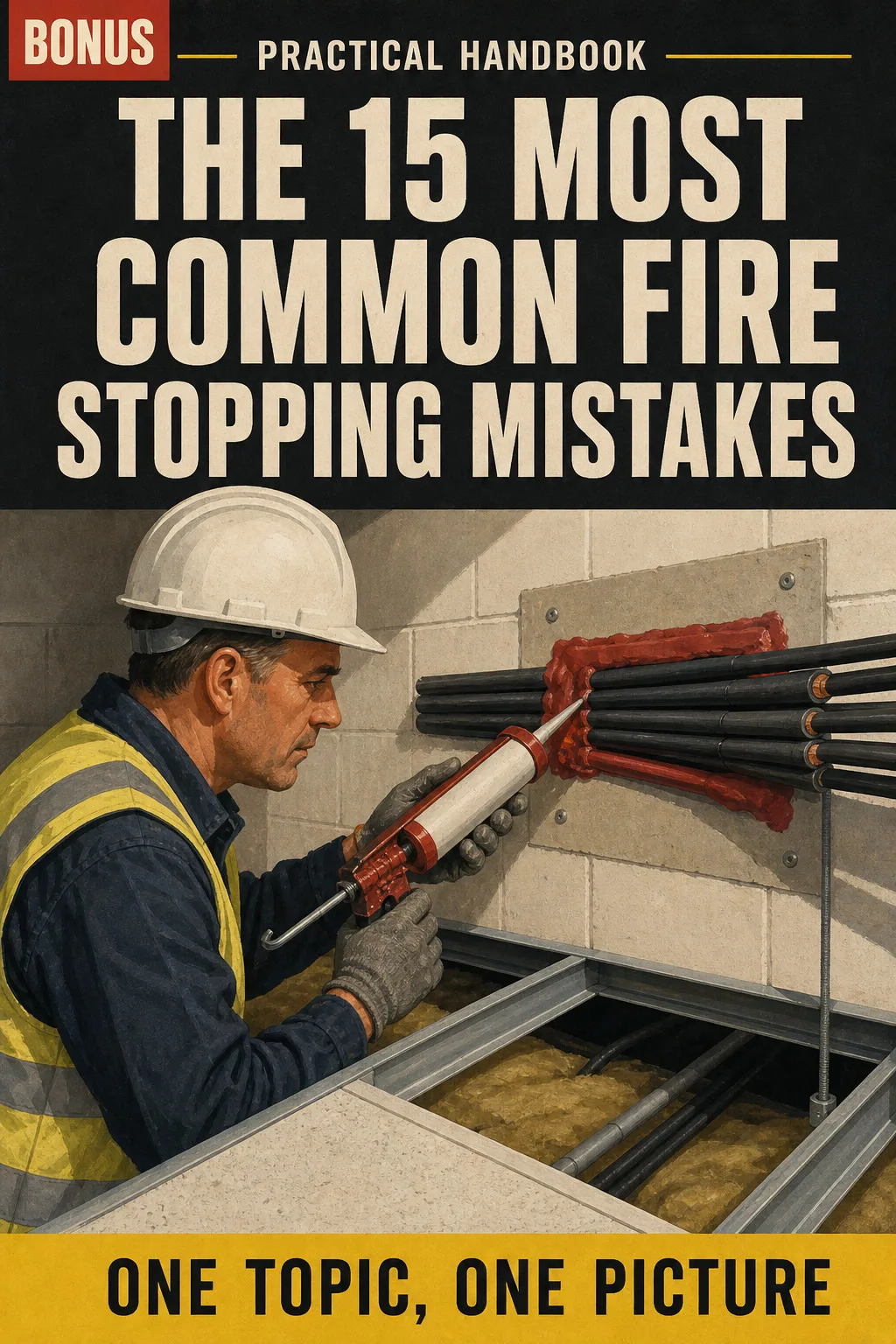
The 15 Most Common Fire Stopping Mistakes

BONUS 2: «The 15 Most Common Fire Stopping Mistakes»

Value on its own: US$ 14.90

See the most frequent installation and survey errors drawn before and after, so you can spot them on site and avoid them in your own work.

Passive Fire Protection Illustrated with 2 Free Books

  • Passive Fire Protection Illustrated: 65 illustrated pagesUS$ 63
  • BONUS 1: Passive Fire Protection Exam-Style QuestionsUS$ 17.90
  • BONUS 2: The 15 Most Common Fire Stopping MistakesUS$ 14.90
  • High-resolution PDF to printIncluded
Total value US$ 95.80
YOUR PRICE:
US$ 27
You save US$ 68.80
YES, I WANT PASSIVE FIRE PROTECTION ILLUSTRATED FOR US$ 27

📄 This is a digital PDF book sent to your email: nothing is printed or shipped.

Secure purchaseEncrypted payment30-day guarantee

PDF by email: We email you Passive Fire Protection Illustrated as a PDF, together with the two free books. It's a single payment: no installments, no extra charges.

Who This Book Is For

You're working through the IFE Level 3 syllabus

You're working through the IFE Level 3 syllabus

Every classification and standard has its own drawing, so E, EI and REI stop blurring together after an evening's revision.

Your exam date is booked

Your exam date is booked

You revise one page a night and finish with the detail sequence on a single sheet, so you can see where everything sits.

You're already on site

You're already on site

You print the pages you need and explain each seal, door or cavity barrier to the client or inspector in the same order every time.

Everything You Get Today

US$ 95.80US$ 27
YES, I WANT PASSIVE FIRE PROTECTION ILLUSTRATED FOR US$ 27

📄 This is a digital PDF book sent to your email: nothing is printed or shipped.

30DAYS
GUARANTEE

30-Day Guarantee

Try Passive Fire Protection Illustrated for 30 days, bonus books included.

We refund everything if the file won't open, if the book isn't what you see here, if you were charged twice or if the email doesn't arrive. Just email us.

You pay once. No subscriptions.

Frequently Asked Questions

Is it for me if I've been on site for years and now need the IFE Level 3?

Yes. It doesn't explain how to hold a mastic gun. It explains why each detail is done the way it is, then takes you through classifications, the rules in England, evidence and records.

Where does the content come from?

Approved Document B (England), the Building Regulations 2010, the Building Safety Act 2022, the Fire Safety Order, the Fire Safety Act 2021, the Fire Safety (England) Regulations 2022, BS EN 13501, BS EN 1366, BS 476, BS 8214 and the IFE Level 3 syllabus. The part on the rules follows England. If you work in Scotland, Wales or Northern Ireland, the fire tests, classifications and site details are the same, but check your own building guidance for periods and duties. Every standard number and value is flagged so you can check it against the official current version.

Is it official material?

No. It's independent study material, not published or endorsed by the IFE, the ASFP, BSI or the government. It doesn't give you a certificate or CPD points: the IFE Level 3 only comes from sitting the IFE exam.

Does it replace the course or training?

No. It helps you revise and understand. It doesn't replace accredited training, the manufacturer's installation instructions or the test evidence for each product.

Are the practice questions the real exam questions?

No. They're written for this book to help you practise each topic, and every answer points you back to the page.

When and how does it arrive?

The book and the 2 free books arrive as PDFs by email, sent to the address you give when you pay.

Do I have to pay every month?

No. It's a one-off payment.

Can I have it on paper?

No printed copy is posted: it's a PDF sent by email. It prints well at home or at a print shop, so you can keep the pages you need in the van.

How does the refund work?

You have 30 days. We refund everything if the file won't open, if the book isn't what you see on this page, if you were charged twice or if the email doesn't arrive: just email us.

Before You Close This Page

No more reading the manual at night and losing it by morning.

Pipe ends, collars and cavity barriers: you see them drawn, and that's it.

You walk into the exam knowing where everything is.

Drawings make studying faster.

The book is right below.

One-time payment: US$ 27 · Guarantee: 30 days · PDF by email

YES, I WANT PASSIVE FIRE PROTECTION ILLUSTRATED FOR US$ 27

📄 This is a digital PDF book sent to your email: nothing is printed or shipped.